A Democratic surge brings Kaufman County’s major races within reach
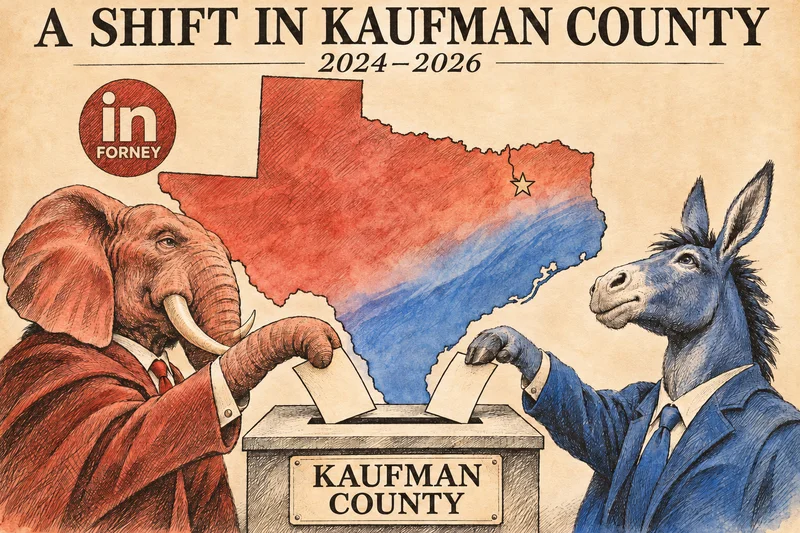
Two years ago, Kaufman County’s major races were comfortable Republican wins. In 2026, they were close contests.
The change reached across the ballot. In races for U.S. Senate, Railroad Commissioner, U.S. House District 5 and Texas House District 4, the Democratic share of the county vote increased by roughly 11 to 14 percentage points. Candidates who had been receiving about one vote in three were approaching one in two.
The Senate race crossed the threshold: a county that favored the Republican nominee by almost 22 percentage points in 2024 gave the Democratic nominee a narrow lead in 2026. In the other three races, Republicans retained their county advantages, but margins that once exceeded 29 points fell to single digits.
Here is how the Democratic share changed:
U.S. Senate
2024: 38.10%
2026: 49.54%
Gain: 11.45 percentage points
Railroad Commissioner
2024: 33.26%
2026: 47.28%
Gain: 14.02 percentage points
U.S. House District 5
2024: 35.31%
2026: 47.52%
Gain: 12.21 percentage points
Texas House District 4
2024: 33.97%
2026: 46.87%
Gain: 12.90 percentage points
All figures describe Kaufman County votes, not statewide or districtwide results. Vote shares include third-party and write-in votes where applicable. Gains are calculated from vote totals before rounding.
The Senate results offer the clearest measure of the distance traveled. In 2020, Democrats received 30.98% of Kaufman County’s Senate vote, against the Republicans’ 66.63%. The Democratic share climbed to 38.10% in 2024 and reached 49.54% in 2026, producing a county lead of 785 votes.
Different candidates ran in those elections, and their individual appeal matters. Still, the progression is striking: a Democratic deficit of more than 35 percentage points became a narrow Democratic lead in six years, with the largest gain coming in the last two. Kaufman County’s official 2020 results
The Senate breakthrough might have been easier to dismiss as an exceptional race had the rest of the ballot remained largely unchanged. It did not.
The largest Democratic improvement came in the Railroad Commissioner contest. The party’s share rose from 33.26% to 47.28%, a gain of 14.02 percentage points. The Republican share fell from 62.43% to 51.01%.
A race separated by more than 29 points in 2024 was separated by fewer than four in 2026. Democrats added 6,694 votes, a 30% increase, even though fewer total votes were cast in the contest.
That result gives the Democratic surge much of its significance. The movement extended beyond the most prominent federal race to another statewide office farther down the ballot.
The congressional and state legislative results followed much the same course.
In U.S. House District 5, the Democratic share of Kaufman County’s vote rose from 35.31% to 47.52%. The Republican advantage narrowed from roughly 29 percentage points to five.
In Texas House District 4, Democrats advanced from 33.97% to 46.87%, reducing a Republican advantage of about 32 points to just over six.
Both House races featured the same Republican nominees in 2024 and 2026. That continuity makes the comparison useful: the county’s movement appeared across different offices and was not confined to contests with an entirely new set of candidates.
Some of the backdrop is familiar to anyone following Kaufman County’s growth. Between 2020 and 2024, the county added more than 50,000 residents—an increase of more than a third, the fastest of any Texas county over that period. Access to Dallas-area jobs and comparatively affordable homes helped attract newcomers, according to reporting by The Texas Tribune. The Texas Tribune
An electorate can change considerably when a county grows that quickly. But growth alone cannot explain the 2026 results. The election reports do not reveal how newcomers voted. And despite an expanding voter roll, fewer people cast ballots.
Registered voters increased from 108,789 in 2024 to 117,763 in 2026. Ballots cast fell from 69,712 to 62,730—a 10% decline. Turnout dropped from 64.08% of registered voters to 53.27%.
Democratic vote totals nevertheless increased in all four races.
Those gains ranged from 17.8% in the Senate contest to 30% in the Railroad Commissioner race. Republican totals declined by approximately one-quarter across the four contests. Together, those changes brought the parties much closer.
This is an important distinction in understanding the blue wave. Democrats attracted more votes in an election with fewer voters overall. Their improved percentages reflected an actual increase in support at the ballot box, alongside a decline in Republican votes.
The returns cannot tell us how much of the change came from voters switching parties, new residents participating or previous voters staying home. A presidential election and a midterm also draw different electorates. Whether this balance will hold in another presidential year remains an open question.
But the breadth of the movement is already clear. Across federal and state offices, Democrats posted double-digit gains in vote share. The Senate result was the most visible breakthrough; the other contests showed how widely the change extended.
Republicans remained ahead in three of the four county comparisons. One election does not establish a permanent realignment, and the available history does not justify calling the results unprecedented.
The significance is substantial without either claim. In 2024, Democrats faced deficits of roughly 20 to 32 percentage points in these races. By 2026, none exceeded seven points, and the party had moved ahead in the Senate vote.
For Kaufman County, that is a different kind of political competition. Races that recently looked out of reach for Democrats are now close enough for both parties to take seriously.