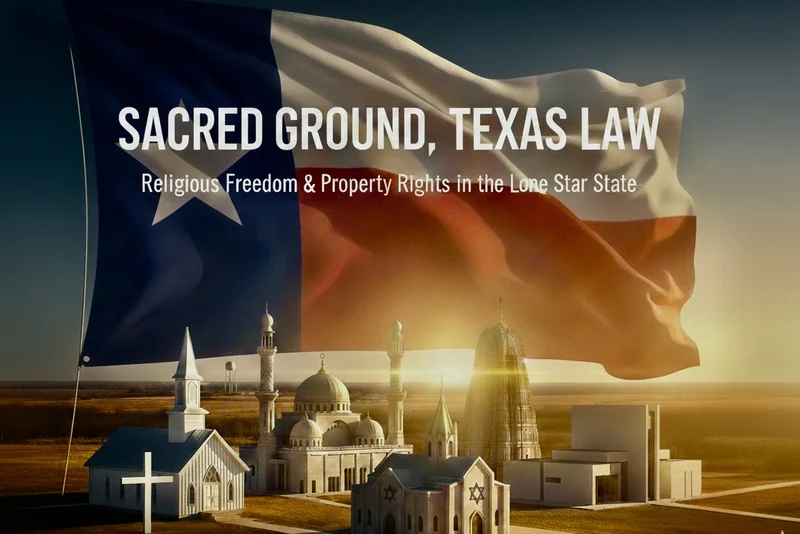
In Texas, the state's political and legal culture has treated property rights and religious expression with a reverence that borders on the absolute. However, as the DFW metroplex expands into Kaufman County, a persistent myth has emerged on social media: that local governments possess the authority to "veto" the construction of mosques or other religious sites.
The reality is exactly the opposite. In Texas, religious organizations—from churches to synagogues to mosques—enjoy a legal shield that secular developers can only dream of. Far from "banning" religious construction, recent laws signed by Governor Greg Abbott have actually reinforced the notion that if you own land in Texas for a religious purpose, the government's ability to halt your plans is historically thin.
The "Super-Permit": Why Faith-Based Building is Favored
To understand why Texas serves as a legal fortress for faith-based construction, one must examine the Texas Civil Practice and Remedies Code § 110.001. Under state law, a "place of worship" is not defined by its architecture or its denomination. It is simply any "building or grounds where religious activities are conducted."
When an organization meets this broad definition, they are protected by the Texas Religious Freedom Restoration Act (TRFRA). This law prohibits cities like Forney from implementing zoning rules that "substantially burden" a religious group unless the government can demonstrate a compelling safety reason—and even then, they must utilize the "least restrictive" method possible.
In plain English: A city can mandate that a mosque include a specific fire hydrant, but they cannot assert that it "doesn't belong" in a certain neighborhood. While a new Starbucks might be entangled in zoning red tape for years, a house of worship often bypasses these hurdles "by right."
The Truth About HB 4211: "Banning Compounds" vs. Protecting Law
A frequent point of confusion on social media centers on House Bill 4211, signed by Governor Abbott in 2025. Critics and online rumors suggested the bill was a targeted ban on Muslim developments or "mosque-led neighborhoods."
However, a reading of the law reveals that it is not designed to block mosques; rather, it aims to preserve the jurisdiction of Texas courts. The law was a response to "EPIC City," a large-scale project in North Texas. HB 4211 ensures that:
Texas Law Rules: No developer can force residents to settle disputes in private religious or foreign tribunals (such as Sharia or ecclesiastical courts). All legal matters must be heard in Texas state or federal courts.
Property Protections: It prevents developers from creating "closed" investment schemes where residents cannot easily sell their homes or are compelled into restrictive "business entity" ownership instead of traditional titles.
The law does not obstruct the construction of a mosque or the formation of a community around it; it simply ensures that the residents of that community have the same legal protections as any other Texan.
The "By Right" Revolution: SB 854
If anything, Texas law is becoming more favorable to religious land use. A separate law, Senate Bill 854, empowers religious organizations to build multifamily housing—such as apartments for their members or seniors—on their own land "by right."
For Forney residents, this means that if a mosque or church owns a plot of land, the City Council cannot employ "Not In My Backyard" (NIMBY) tactics to block housing or worship facilities. The city’s role is reduced to ensuring that plumbing works and traffic lights are timed—the mission of the building itself is legally untouchable.
The Bottom Line
For those asking, "Didn't Abbott ban this?" the answer is no. Texas remains one of the most protected environments in the country for religious land use. While the state has moved to ensure that no "private legal enclaves" are created outside of Texas law, it has simultaneously reinforced the rights of religious groups to build sanctuaries, schools, and homes wherever they own the land.
Learn More
Texas Statutes & Legal Definitions
Texas Civil Practice and Remedies Code § 110.001 – Legal definition of "Place of Worship" and "Free Exercise of Religion."
Texas Religious Freedom Restoration Act (TRFRA) – Detailed protections against government "substantial burdens" on religious exercise.
Recent Legislation (89th Session)
Texas House Bill 4211 (2025) – Regulation of business entity-owned residential arrangements and court jurisdiction.
Texas Senate Bill 854 (2025) – Empowering religious organizations to build housing "by right."
Federal Oversight
Department of Justice: RLUIPA Summary – How federal law protects religious land use from discriminatory zoning.