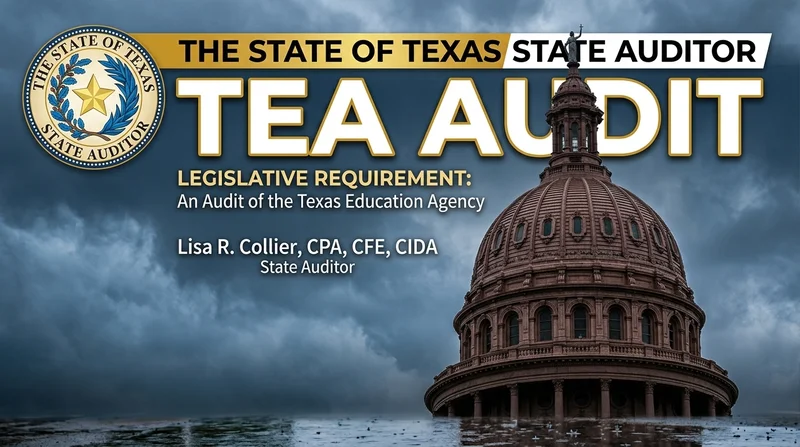
A new state performance audit exposed top-heavy management, lax grant monitoring, and compliance gaps at the Texas Education Agency (TEA). The state findings align with a period of heightened scrutiny for local education: Forney ISD recently agreed to a federal civil settlement regarding mandatory reporting compliance tied to federal funds, while joining a statewide school district coalition that successfully blocked the release of TEA’s latest A–F academic ratings in court.
FORNEY, TX — A state performance audit released this month by the Texas State Auditor’s Office (SAO) has revealed system-wide oversight gaps, heavy administrative payrolls, and compliance failures at the Texas Education Agency (TEA).
The audit comes during a tumultuous period for public education across North Texas, landing right alongside major federal legal actions against Forney Independent School District (FISD) and ongoing statewide legal battles over TEA’s academic rating system.
Audit Findings: Top-Heavy Management and Oversight Gaps
The SAO performance audit examined the TEA’s administrative processes, grant distributions, contracting practices, and charter school oversight covering fiscal years 2024–2025. While the audit acknowledged that the agency established comprehensive foundational policies, it highlighted several high- and medium-risk operational breakdowns:
Top-Heavy Management Ratios: By state law, large state agencies are required to maintain a ratio of at least 11 staff employees for every 1 manager. As of August 31, 2025, TEA operated at a 1-to-3.5 ratio without required state approval. Management salary costs jumped 64% from 2021 to 2025, reaching $44.7 million.
Inconsistent Grant Monitoring: TEA disbursed $1.9 billion in state-funded grants over two years. However, because the agency lacked baseline monitoring guidelines, several internal departments failed to track grant performance metrics or monitor non-competitive discretionary grants.
Pre-K Expansion Oversight: The audit found TEA failed to verify whether public and charter school districts expanding early childhood programs were confirming that their private pre-K partners met state licensing and class-size standards.
Contracting & Security Discrepancies: Nearly 18% of tested contract evaluators failed to submit mandatory nepotism disclosures prior to awarding contracts. Additionally, 11 grant approval notices were issued bearing the auto-populated digital signature of an employee who had already left the agency.
TEA agreed with all audit recommendations, pledging to establish minimum grant monitoring rules and seek approval from the Legislative Budget Board for its staffing structure.
Relevance to Forney ISD: Federal Scrutiny & Mandatory Reporting
While the SAO audit evaluated TEA's administrative headquarters, its findings on grant oversight and regulatory compliance hit close to home following breaking federal enforcement actions against Forney ISD.
The U.S. Attorney’s Office for the Northern District of Texas launched "Project Safe Schools," targeting district-level failures to report educator misconduct. As part of the initiative, Forney ISD agreed to pay a $14,308 civil settlement under the False Claims Act to resolve allegations that it submitted misleading certifications regarding compliance with mandatory reporting laws while applying for federal Special Education (IDEA) funds.
Simultaneously, federal authorities unsealed criminal charges against a former Crosby Elementary Principal and a special education teacher following allegations that the principal helped facilitate the teacher's hiring despite knowing of prior abuse allegations and an evasive legal name change.
The systemic breakdown in localized compliance mirrors the state auditor's broader warning: without rigorous, standardized monitoring from regulatory bodies like the TEA, local compliance mechanisms can break down undetected.
What About A–F Accountability Ratings?
Local parents tracking school performance metrics may wonder how this audit impacts Forney ISD's state letter grade.
The SAO audit dealt strictly with TEA’s internal financial, contracting, and administrative management—it did not evaluate or alter district academic scores. Official A–F campus and district accountability ratings remain embroiled in statewide litigation. Forney ISD was among a coalition of Texas school districts that successfully obtained court injunctions blocking the TEA from releasing refreshed A–F grades, arguing that the state's updated STAAR scoring methodology was flawed and applied unfairly.
As TEA works through its corrective action plans to tighten administrative controls, local education leaders remain under intense pressure to maintain high standards of compliance, fiscal reporting, and student safety.