Forney, Texas, was founded on the promise of the horizon. Originally known as Brooklyn, the town was renamed in 1873 to honor John W. Forney, an influential railroad official who helped guide the Texas and Pacific Railway through the fertile blackland prairie. For more than a century, the community was defined by its agricultural heritage and its hard-earned reputation as the "Antique Capital of Texas." It was a place where history lived in the storefronts of Main Street. However, as the Dallas-Fort Worth Metroplex expanded eastward, this quiet hub began a transformation that would test the limits of its small-town character.
The Annexation Wars: A Fight for the Prairie
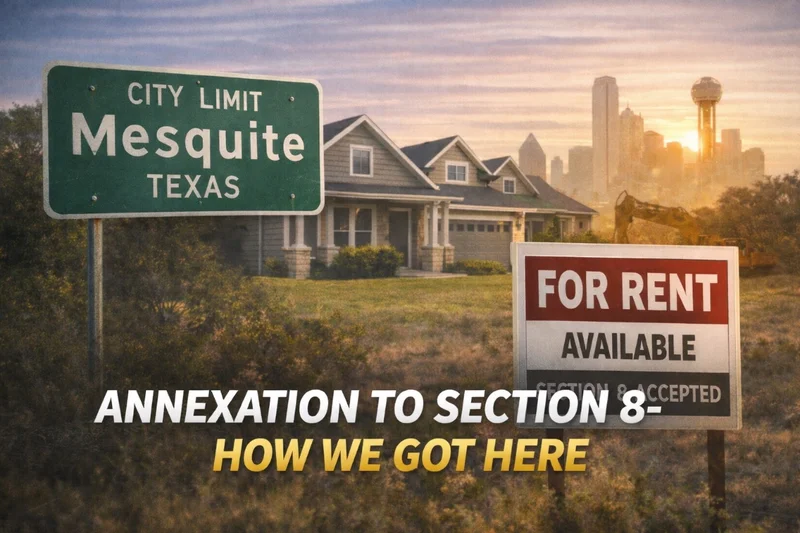
The modern struggle for Forney began with a fierce battle for local control. For decades, Texas cities utilized a system that allowed them to unilaterally absorb surrounding rural land. In Kaufman County, residents who had moved to the open country for a slower pace of life began to view the expanding city limits of Mesquite and Forney as a threat to their independence. Many families felt they were facing a race against the clock to preserve their way of life as cities hurried to claim land before new state regulations took effect.
The tension reached a breaking point in late 2017. When Mesquite moved to annex nearly 9,000 acres, it sparked a sophisticated legal defense from local property owners and state officials. By December, the community’s persistence proved successful when Mesquite agreed to halt its plans as part of a landmark legal settlement. This victory for local property owners was eventually codified into state law through comprehensive annexation protections, effectively ending forced annexation across the state.
To ensure long-term autonomy, many residents opted to create their own small municipalities. This era of defensive incorporation led to the rise of micro-cities such as Talty and Post Oak Bend. While these new boundaries successfully kept larger cities at bay, they also created a regulatory vacuum that would soon be targeted by a different kind of power: institutional real estate capital.
The Section 8 Pivot: Lessons from Providence Village
While the annexation wars were about the land, the subsequent conflict shifted toward the people who lived on it. The conversation evolved following a landmark case in Providence Village, a community north of Dallas. In 2022, a homeowners association (HOA) attempted to bar landlords from renting to tenants using Section 8 vouchers. While the HOA cited safety concerns, a federal investigation concluded that the move created a hostile environment.
The Texas Legislature responded by passing HB 1193, which prevents HOAs from discriminating based on a tenant's method of payment. For the state, it was a move to protect property rights and ensure fair housing. For Forney, however, it meant that the composition of its new neighborhoods would be increasingly shaped by global economic forces rather than local community guidelines.
Algorithms as Landlords: The Investor Wave
This shift coincided with a surge of interest from institutional investors. Large firms began acquiring single-family houses at a massive scale. By late 2025, investor-owned properties accounted for nearly 19 percent of the market in Kaufman County. In the 75126 zip code, which covers the heart of Forney, thousands of homes are now managed by corporate entities.
Councilmember Sarah Salgado has been vocal about how this shift impacts the town. In an interview with InForney, she noted that the growth of investor-owned rentals in the Dallas area has outpaced much of the country, warning that these trends often lead to more transient neighborhoods. Salgado emphasized that the Dallas Housing Authority is directing many of its most vulnerable residents to Forney, a change that she believes requires stronger local oversight.
Councilmember James Traylor has also called for a proactive approach. In a recent call for community action, Traylor warned: "This is bigger than Forney. Local cities are being boxed in by the state, while the federal government pours billions into housing programs that often serve investors more than families. The explosion of single-family rentals is putting real strain on our community, and leaders in Austin and Washington need to recognize the damage being done to towns like ours."
The Cost of Corporate Ownership
Traylor is particularly concerned with the economics of the Section 8 program when it intersects with institutional capital. He argues that "a program built to help families should not routinely pay more than ownership costs in the same market." To Traylor, recent debates over rental housing regulations highlight that the current system often acts as a transfer of wealth from taxpayers to large investors, treating homes as financial instruments rather than residences. Many corporate landlords have been criticized for piling on extra fees, and a federal investigation found that these entities filed for thousands of evictions even during the global pandemic. Traylor believes it is vital to hold entities accountable, pointing out that currently, taxpayers are subsidizing the cost of policing and monitoring single family investor owned housing. He believes it is time for the investors to carry their share of the load.
A Community Winning Back its Future
While the challenges of rapid growth are real, the heart of Forney remains strong. The same community spirit that won the annexation battles is now being channeled into grassroots projects that support every resident. Organizations like the Forney Legacy Project are a perfect example of this resilience, bringing together neighbors to support families in crisis. This project was started by three local moms to stand in the gap for neighbors facing unimaginable challenges, proving that the town's greatest asset is its people.
Forney is a town that has always known how to adapt. From its beginnings as a railroad stop to its status as a booming modern suburb, it has survived by sticking together. Local leaders are now working to increase rental registration fees and strengthen code enforcement to ensure that the City Without Limits remains a safe and welcoming place.
Councilmember Traylor remains committed to protecting the community's heritage. He notes that "Forney was built on the dream of homeownership, sacrifice, and hard work. That legacy should not be eroded by landlords who put profits above people and community. I will use every tool available to fight back and bring Forney back to its roots." The horizon that once called to railroad pioneers still holds promise for the families of today. Forney is not just a collection of properties; it is a community that refuses to be defined by anything other than its own enduring spirit.