FORNEY, TX — Recent data from the U.S. Census Bureau reveals that Kaufman County is experiencing significant growth in its immigrant population, reflecting the broader demographic shifts occurring across North Texas.
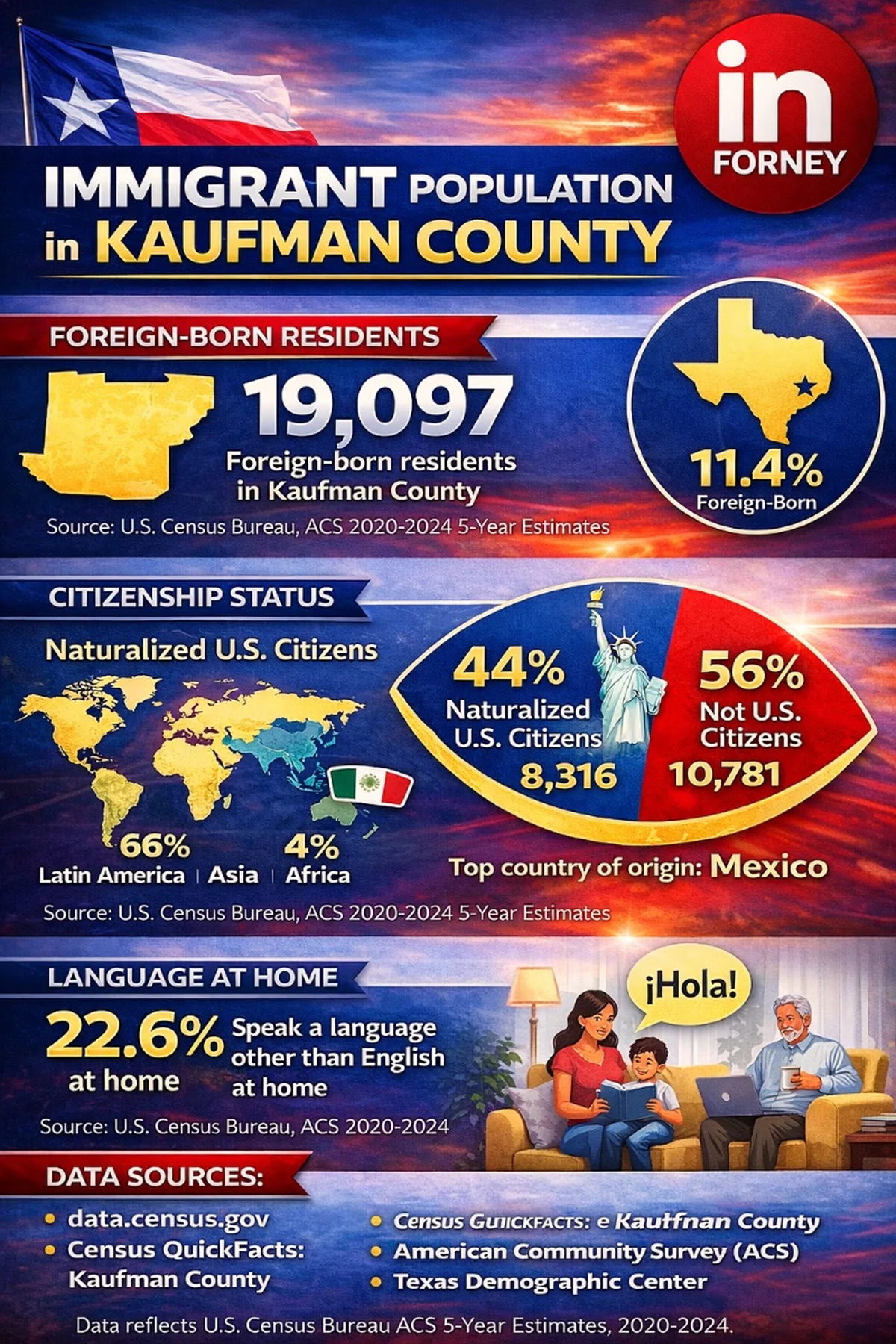
According to the American Community Survey (ACS), an estimated 19,097 residents of Kaufman County were born outside the United States, which represents 9.7 percent of the total population, based on the latest 2024 ACS 1-year estimates.
Source: U.S. Census Bureau, American Community Survey 1-Year Estimates (2024), Table DP02
Longer-term data provides additional context. The ACS 2020–2024 5-year estimates average survey responses over five years to mitigate year-to-year fluctuations, indicating that approximately 11.4 percent of Kaufman County residents are foreign-born.
Source: U.S. Census Bureau, ACS 5-Year Estimates (2020–2024), QuickFacts
Latest Census Data
Unlike the once-a-decade national Census, the American Community Survey is a continuous survey that gathers data throughout the year and releases results on a delayed schedule to ensure accuracy and statistical reliability. The latest ACS releases reflect data collected during calendar year 2024, with final datasets expected to be made public in 2025.
For smaller geographic areas like counties, the Census Bureau heavily relies on 5-year estimates, which aggregate responses from multiple years to yield more dependable statistics. Consequently, 2024 currently represents the most recent official demographic data available for Kaufman County regarding immigration, citizenship status, and language use.
Local governments, school districts, researchers, and federal agencies often utilize ACS data despite the time lag, as it remains the most comprehensive and standardized source for monitoring population trends between decennial censuses.
Source: U.S. Census Bureau, American Community Survey Methodology
Citizenship Status: Naturalized vs. Non-Citizen
The Census data also categorizes Kaufman County’s foreign-born population by citizenship status.
Among foreign-born residents in the county:
Approximately 44 percent are naturalized U.S. citizens
Approximately 56 percent are not U.S. citizens
The Census Bureau notes that non-citizens include lawful permanent residents, visa holders, refugees, and other residents. The ACS does not gather information on immigration enforcement status or classify individuals as undocumented.
Source: U.S. Census Bureau, ACS 5-Year Estimates (2020–2024), Table B05001 – Nativity and Citizenship Status
Where Kaufman County’s Immigrants Come From
The ACS also tracks regions and countries of origin, shedding light on how immigration patterns influence local communities.
In Kaufman County, the majority of foreign-born residents come from Latin America, followed by Asia, with smaller populations from Europe and Africa. Specifically, Mexico is the most common country of origin among foreign-born residents, with immigrants also arriving from various Central American, South American, and Asian nations.
Source: U.S. Census Bureau, ACS 5-Year Estimates (2020–2024), Table S0501 – Selected Characteristics of the Foreign-Born Population
Language Use Highlights Local Impact
These demographic trends are evident in daily life across Kaufman County.
The Census estimates that 22.6 percent of residents aged five and older speak a language other than English at home, a statistic frequently utilized by school districts and local governments for planning language access, educational programs, and public services.
Source: U.S. Census Bureau, ACS 5-Year Estimates (2020–2024), Table DP02
Census officials emphasize that speaking a language other than English at home does not imply non-citizenship. Many bilingual households include naturalized citizens and U.S.-born children.
Local Context Within a National Debate
While immigration policy is often a topic of national debate, the Census data reflects residency patterns rather than enforcement activity or legal status. For Kaufman County, the figures indicate a population below that of major urban counties in North Texas, yet still demonstrate steady growth associated with regional development and population influx.
Local governments, school districts, and community organizations frequently rely on ACS data when applying for grants, projecting service needs, and planning infrastructure in rapidly growing areas such as Forney and its surrounding communities.
Immigration Data FAQ: What This Census Data Does (and Doesn’t) Show
Is this data current?
Yes. The figures cited in this report originate from the U.S. Census Bureau’s American Community Survey (ACS). The most recent available county-level data reflects 2024 survey results, released in 2025.
Why doesn’t the data show 2025 or 2026 numbers?
The ACS collects data continuously but releases results on a delayed schedule to ensure accuracy. For counties, the Census Bureau relies heavily on 5-year estimates, which aggregate multiple years of data to produce statistically reliable results.
Does this data show whether someone is undocumented?
No. The Census Bureau does not collect information on immigration enforcement status. The data identifies whether someone is foreign-born, whether they are a naturalized U.S. citizen, or whether they are a non-citizen.
Are non-citizens the same as undocumented immigrants?
No. Non-citizens include lawful permanent residents, visa holders, refugees, asylum seekers, and other residents. The ACS does not distinguish between these categories.
Does speaking another language mean someone is not a U.S. citizen?
No. Many bilingual households comprise naturalized citizens and U.S.-born children. Language spoken at home is a demographic measure, not a citizenship indicator.
Why does InForney use Census data?
The ACS is the most comprehensive and standardized data source available for local demographic reporting. It is widely used by local governments, school districts, researchers, and federal agencies for planning and policy decisions.
Data Disclaimer
All figures cited in this story are estimates from the U.S. Census Bureau’s American Community Survey and are subject to margins of error, particularly for smaller geographic areas. The data reflects population trends and residency patterns and should not be interpreted as a measure of immigration enforcement activity or legal status.
Learn More: Immigration & Demographics Data Sources
U.S. Census Bureau – Data Portal
Census QuickFacts: Kaufman County