A Republican analyst’s post-election report helps explain why Kaufman County’s once-comfortable GOP margins narrowed, and why two Forney-area incumbents lost.
In Kaufman County, the change could be measured in offices lost and margins nearly erased. Democrats defeated two Republican incumbents in Precinct 2. Across four major races, candidates who had drawn roughly a third of the county’s vote in 2024 were approaching half.
The question after Nov. 3 was how far that change extended.
Derek Ryan’s post-election analysis offers an answer: well beyond Forney. Across Texas, the Republican advantage among voters with primary-election histories shrank sharply. Millions of people who had skipped the previous two midterms participated. Rural counties delivered smaller Republican margins and a smaller share of the statewide vote.
Ryan knows the Republican electorate professionally. Before founding Ryan Data & Research, he worked for the Republican Party of Texas, where his responsibilities included opposition research, voter targeting and management of the party’s master voter file, according to his University of Texas biography.
His report describes an election Republicans lost through an unfavorable combination of turnout and voter choices. It also rejects claims that the results were stolen.
The advantage Republicans lost
Ryan said his database accounted for 99.9% of voters in the election. His analysis tracks who voted, using participation histories and demographic information. It cannot reveal an individual’s secret ballot.
One number captures the Republican problem.
In 2018, voters with Republican primary histories outnumbered those with Democratic primary histories in the general election by about 1.2 million. In 2022, the Republican advantage was roughly 876,000. This year, it was 186,739.
That left Republicans with much less room to absorb losses among voters without primary histories, a group Ryan concluded had favored Democrats heavily.
Absences mattered, too. Ryan counted about 591,000 people with Republican primary histories who did not vote, compared with 511,000 with Democratic primary histories. Those are participation categories, not proof of how the missing voters would have voted.
The report also complicates the idea that the election turned solely on Republicans staying home. About 2.7 million people voted after participating in neither the 2018 nor the 2022 midterm. They supplied 27% of the electorate.
Many already knew their way to a polling place. About 1.5 million had voted in the 2024 presidential election. They were new to these recent midterm comparisons, not necessarily new residents or first-time voters.
At the same time, about 1.4 million people who had voted in at least one of the previous two midterms did not participate. The familiar electorate had changed considerably.
What that looked like in Kaufman County
The local returns show the effect across offices.
InForney’s earlier comparison found that the Democratic share of Kaufman County’s U.S. Senate vote rose from 38.10% in 2024 to 49.54% in 2026.
The gains extended down the ballot. In the Railroad Commission race, the Democratic share increased from 33.26% to 47.28%. In U.S. House District 5, it rose from 35.31% to 47.52%. In Texas House District 4, it climbed from 33.97% to 46.87%.
Those figures represent Kaufman County votes, not statewide or districtwide outcomes.
The county cast fewer ballots than in 2024, yet Democratic vote totals increased in all four races. Republican totals declined by approximately one-quarter, according to that analysis.
The Railroad Commission result is particularly revealing. A contest farther down the ballot registered an even larger Democratic gain in vote share than the Senate race. The movement was too broad to describe simply as one candidate’s appeal.
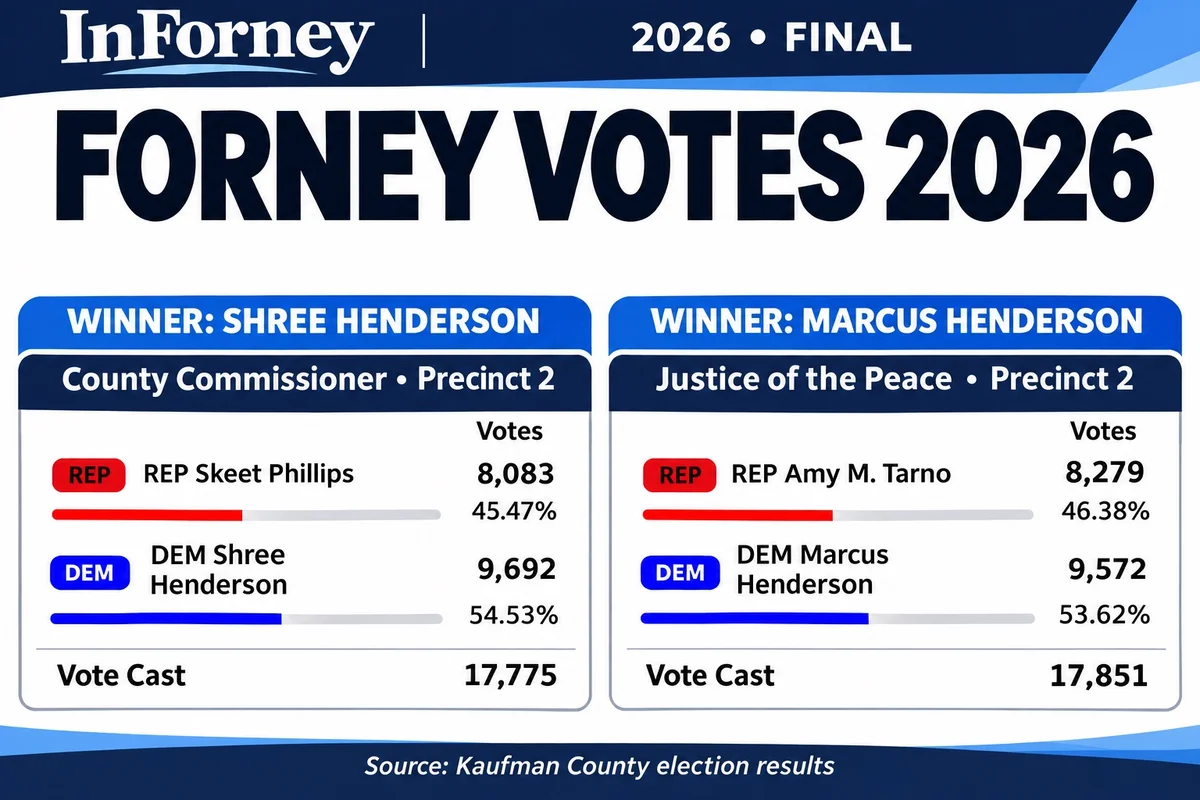
In Precinct 2, it was sufficient to remove incumbents. InForney reported that Shree Henderson defeated Skeet Phillips for county commissioner, 9,692 votes to 8,083. Marcus Henderson defeated Amy M. Tarno for justice of the peace, 9,572 to 8,279.
Those results cover the precinct serving the Forney area. They are not a city-only vote count.
The local and statewide comparisons also begin in different years. InForney measured the change from the 2024 presidential election; Ryan frequently used the 2022 and 2018 midterms. They describe related developments, but they are not interchangeable measures of the same electorate.
Rural counties offered less protection
Ryan’s regional analysis shows why Republican weakness could not be repaired simply by running up the vote outside the cities.
He grouped Texas into its five largest counties by registered voters, the next 20, and the remaining 229, which he describes as mainly rural.
In his comparison with 2022, the Democratic advantage in the five largest counties grew from 16.7 percentage points to 36.7. The Republican advantage in the mainly rural group fell from 55 points to 31.9.
That last group also accounted for only 23.7% of the statewide vote, down 1.8 percentage points from 2022.
Republicans were winning those counties by less, while those counties supplied less of the electorate. Both changes made the losses elsewhere harder to overcome.
Other participation shifts favored groups Ryan considered more likely to support Democrats. Voters ages 18 to 29 accounted for 14% of ballots, compared with 12% in 2022. Their turnout rate reached 35%, up 10 percentage points. Women cast 55% of ballots, one percentage point above their share in each of the previous two midterms.
Those statewide figures do not establish who supplied the winning votes in Precinct 2. They do help explain why a Democratic breakthrough there occurred alongside much wider Republican losses.
No Evidence Of Voter Fraud
Ryan addressed the allegations directly in his report.
“I have seen posts on social media claiming that the election was stolen in Texas,” he wrote. “The data simply does not prove that.”
Independent reporting has also found that a prominent claim used to question the results does not withstand scrutiny.
A Nov. 9 fact-check by Lucio Vasquez of The Texas Newsroom, published by Texas Standard, examined allegations built around nearly 2.9 million Texas voter registrations recorded between 2022 and 2024.
The federal report being cited did not identify 2.9 million illegal voters. Its registration category included people moving into Texas or between counties. After removals and other changes, the state’s voter rolls grew by roughly 952,000 during that period.
The records also predated this election. They covered the period before the 2024 presidential vote, which Donald Trump won in Texas.
The fact-check found that the figures did not establish widespread fraud or show that illegal votes affected the 2026 results. That is a narrower, supportable conclusion than asserting that no isolated violation could have occurred anywhere in Texas.
The state’s verification work is not finished. A Nov. 4 notice from the Texas secretary of state schedules the statewide risk-limiting audit to begin Nov. 19. As of Nov. 13, that audit cannot be cited as a completed finding.
What one election can tell us
Ryan is cautious about predicting a permanent Democratic majority. His report argues that both parties remain capable of winning and that the next two years, along with the candidates on the 2028 ballot, will matter.
The local evidence warrants the same restraint. Republicans remained ahead in three of the four Kaufman County comparisons, even after substantial Democratic gains. Nor can aggregate returns tell us precisely how much came from people changing their votes, entering the electorate or staying home.
What they can tell us is consequential enough.
Democrats gained votes in Kaufman County even as overall participation fell from the presidential election. The gains extended beyond the Senate contest. In the Forney area, they reached two county offices.
Ryan’s report gives those results a statewide context. An advantage Republicans had relied upon was no longer large enough. In Precinct 2, the cost was two incumbents’ jobs.
Learn more
Texas secretary of state: 2026 statewide election results. State-reported returns for federal, statewide and district races.
Ryan Data & Research: 2026 post-election report. The report supplied for this article provides the statewide participation figures and Ryan’s analysis.
Texas Standard / The Texas Newsroom: Why the viral voter-registration claim does not prove fraud. Reporting on the federal data and what it actually measures.
Texas secretary of state: Nov. 4 post-election audit notice. The state’s audit schedule and instructions to county election officials.
Kaufman County Elections: Official results portal. County election returns and reconciliation documents.
InForney: Kaufman County’s shrinking Republican margins. The county’s 2024 and 2026 comparison.
InForney: Democrats flip two Precinct 2 offices. The commissioner and justice of the peace results.