Long before the suburbs stretched across the horizon and the I-30 bridge flickered with commuters, the landscape of North Texas was a vast, unforgiving sea of tallgrass prairie. In the mid-19th century, if you lived in the settlement of Rockwall, you weren’t a "Rockwallian"—you were a citizen of Kaufman County.
But as any early settler would tell you, being part of Kaufman County in the 1850s and 60s wasn't just a matter of geography; it was a matter of survival.
The Long Trek to Kaufman
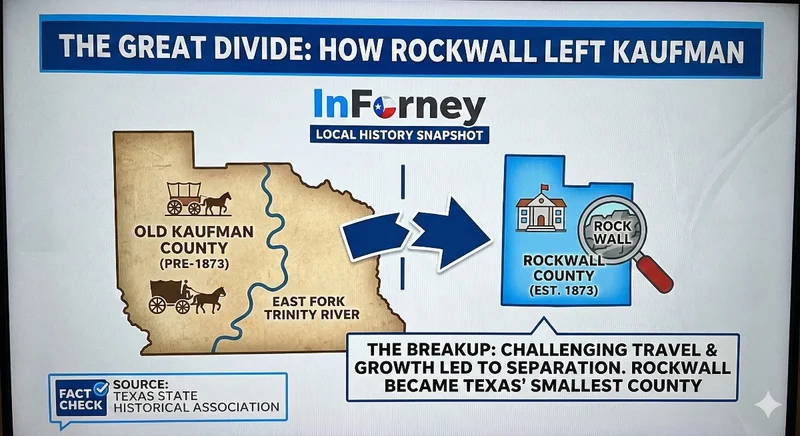
In the early days of Texas statehood, Kaufman County was a massive administrative block. For the pioneers living in the northern reaches—what we now know as Rockwall, Heath, and Fate—the county seat of Kaufman was nearly 20 miles away.
While 20 miles sounds like a quick errands run today, in the 1870s, it was a grueling day-long journey. Travelers had to contend with:
The East Fork of the Trinity: During the rainy season, the river and its bottomlands became an impassable swamp of "black-land gumbo" mud.
Logistical Limbo: If a farmer needed to file a land deed, serve on a jury, or pay taxes, they had to abandon their crops for days to navigate the treacherous terrain to the Kaufman courthouse.
By the early 1870s, the frustration reached a breaking point. The settlers in the north felt neglected and isolated by the natural barrier of the river bottoms.
The Birth of a New County
The movement for independence was led by influential local figures like W.W. Boyd and Benjamin Boydstun. They argued that the population had grown enough to sustain its own government and that the mysterious "Rock Wall" geological formation provided a unique identity for a new district.
On March 1, 1873, the Texas Legislature officially carved Rockwall County out of the northern portion of Kaufman County.
The split wasn't just a political divorce; it was a record-breaking move. Because the organizers only took what was absolutely necessary to function, Rockwall became—and remains—the smallest county in Texas by land area, covering only about 149 square miles.
A Legacy of Two Neighbors
The separation was largely amicable, driven by the practicalities of 19th-century life. Kaufman County continued to flourish as an agricultural powerhouse (with Forney becoming a world-renowned hay capital), while Rockwall began its journey as an independent seat of commerce.
For residents of Forney, this history is a reminder of how the very ground beneath us was once part of a much larger frontier puzzle. While the "Yellowjackets" and the "Jackrabbits" might be rivals today, they share a common ancestry rooted in the blackland prairies of the 1800s.
Sources & References
Texas State Historical Association (TSHA): The Handbook of Texas Online, "Rockwall County" and "Kaufman County."
Rockwall County Historical Foundation: Records on the 1873 Legislative Act of Separation.
Kaufman County Historical Commission: Archives regarding early county boundaries and the creation of the North Fork settlements.
Local History Archives: The History of Rockwall County by O.L. Steger.
Learn More
If you want to dive deeper into the shared history of our region, check out these resources:
Texas State Historical Association: Rockwall County History – A comprehensive look at the county's formation and the 1873 legislative act.
The Rockwall County Historical Foundation – Visit the museum at Harry Myers Park to see artifacts from the era of the split.
The Handbook of Texas: Kaufman County – Learn about the "Mother County" from which Rockwall was born.
Texas General Land Office: Historical Map Collection – Search for 19th-century maps to see how the boundaries evolved in North Texas.